Who is it for?
Liver ablation treats early-stage primary liver tumors (hepatocellular carcinoma) and selected, limited liver metastases. It is a strong option especially for patients who are not surgical candidates or prefer not to have surgery; in suitable cases it is used with curative intent.
Suitability depends on tumor size, number, location and overall liver condition, and is decided at a multidisciplinary board — liver surgery, oncology, gastroenterology and interventional radiology — together with the patient.
How it is done — step by step
Planning
The tumor is mapped with ultrasound, and CT/MRI when needed; the safest needle path is planned.
Anaesthesia
For comfort, the procedure is performed under sedation or with the anaesthesia team; you feel no pain.
Ablation
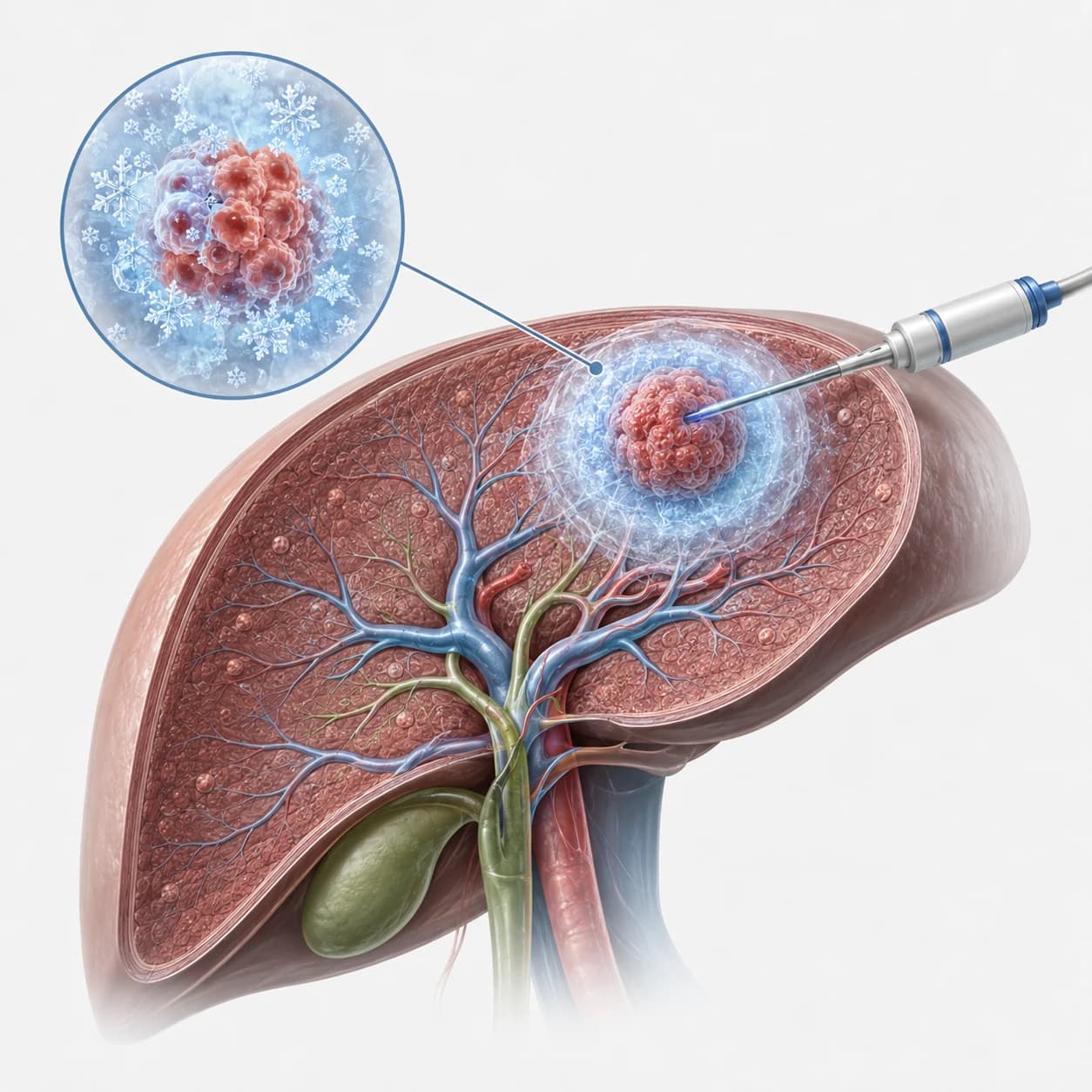
Under image guidance, a thin needle-antenna is placed in the tumor center. Microwave or radiofrequency energy inactivates the tumor with a safety margin, watched live on screen.
Check
The ablation zone is imaged at the end; only a needle mark remains on the skin.
What to expect on the day
You will be asked to fast; your medications (especially blood thinners) are adjusted in advance. The procedure usually takes 30–90 minutes.
You are closely observed for several hours; some patients go home the same day, others after one overnight stay — planned in advance according to tumor location and overall condition.
Risks and Limitations
Pain, fatigue and mild fever lasting a few days can occur — known as post-ablation syndrome — and settle on their own. Bleeding, infection, bile duct or adjacent organ injury are rare; image guidance and experience keep these risks minimal.
Limits: for large tumors, multiple lesions or critical locations, ablation alone may not suffice; it is then combined with other treatments or another path is recommended. Ablation does not replace oncologic surveillance — regular imaging for new lesions continues.
Recovery and follow-up
Most patients return to daily life within a few days; avoiding heavy lifting for the first week is sufficient.
Treatment response is assessed with CT or MRI about a month after the procedure and at regular intervals thereafter. If needed, the same treatment can be repeated — repeatability is a key advantage of ablation.
Scientific References
- AASLD — Hepatoselüler karsinomda önleme, tanı ve tedavi uygulama kılavuzu (Singal AG ve ark., Hepatology, 2023)
- EASL — Hepatoselüler karsinom klinik uygulama kılavuzu (Journal of Hepatology, 2018)
- BCLC evreleme ve tedavi stratejisi: 2022 güncellemesi (Reig M ve ark., Journal of Hepatology, 2022)
- Dernek kaynakları: CIRSE (Avrupa Girişimsel Radyoloji Derneği) · SIR (ABD) · SIO (Society of Interventional Oncology) · TGRD (Türk Girişimsel Radyoloji Derneği)
Frequently Asked Questions
Is non-surgical treatment really possible?
Yes — for tumors of suitable size and location, ablation is delivered through a needle without any incision, with curative intent in appropriate cases. Suitability is assessed at a multidisciplinary board.
Which tumors are treated?
Early-stage hepatocellular carcinoma and selected, limited metastases. Size, number and location are assessed together.
Will I feel pain during the procedure?
No — it is performed under sedation or anaesthesia care. The few days of soreness afterwards are well controlled with medication.
Do I need to stay in hospital?
Some patients are discharged the same day; for others a one-night observation is planned. This is clarified with you beforehand.
What if the tumor recurs?
A key advantage of ablation is repeatability. If follow-up imaging shows a new or residual lesion, the treatment can be planned again.
Does it affect my chemotherapy?
Ablation is delivered as part of your oncologic plan; your medical treatments continue as scheduled by your oncology team.
The information on this page is for general education; diagnosis and treatment decisions are made individually after clinical evaluation.