
Who is it suitable for?
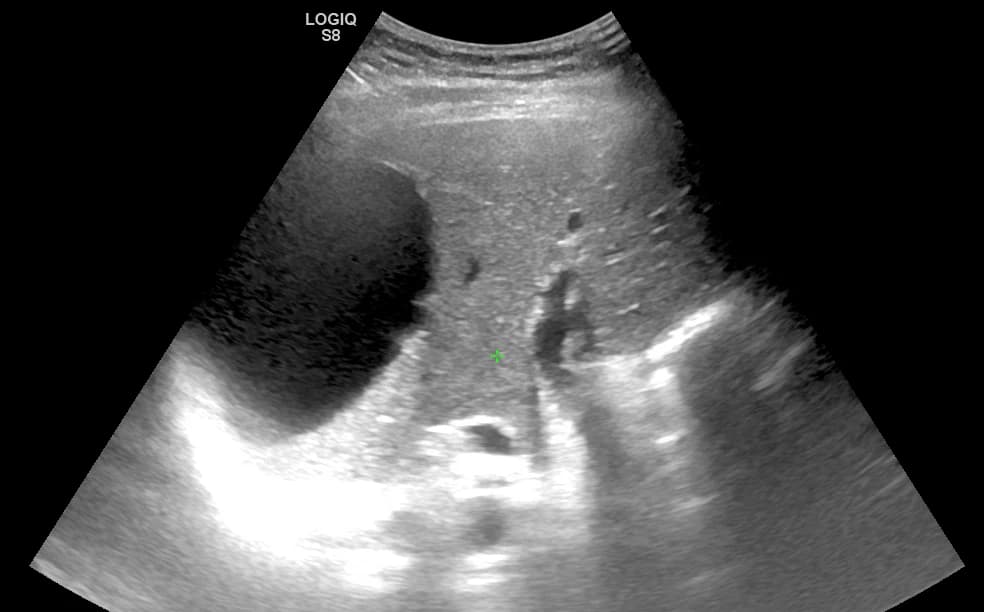
Simple liver cysts are common and the great majority cause no symptoms at all; they are usually found incidentally on an ultrasound or CT performed for another reason. A cyst that causes no symptoms is not treated merely because it is large — as a rule such cysts are simply monitored.
Treatment comes into question when the cyst causes symptoms: fullness or pain in the upper right abdomen, early satiety, a sense of pressure on the stomach, shortness of breath; or when a complication such as bleeding into the cyst or infection develops. In polycystic liver disease, where many cysts are present, the aim is not to treat every cyst; the dominant cysts responsible for the symptoms are selected and addressed.
The most critical step before the procedure is establishing that the cyst is genuinely a simple, non-parasitic cyst. Hydatid cysts and cystic tumours (cystadenoma/cystadenocarcinoma) follow an entirely different path and are not suitable for needle sclerotherapy. Your physician makes this distinction with ultrasound, MRI or CT and, where needed, blood tests.
How is it performed? — Step by step
Planning
The cyst is reassessed with ultrasound and cross-sectional imaging; its contents are confirmed to be clear and free of suspicious findings such as a thick wall, septations or vascularised tissue. The safest access route is determined.
Preparation
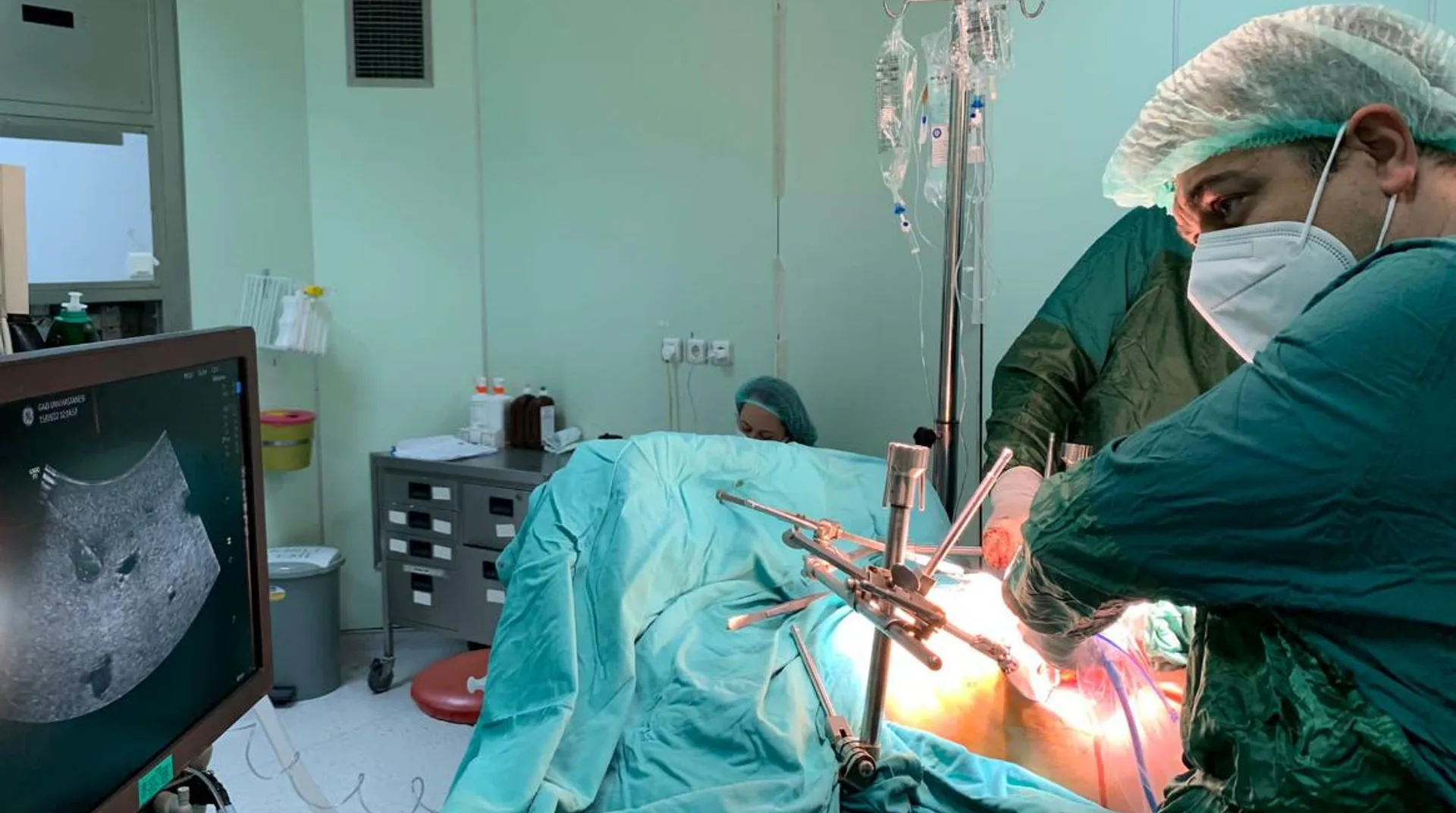
The skin is cleaned with an antiseptic solution and the entry site is numbed with local anaesthesia. The procedure is performed under ultrasound guidance, with CT assistance where required. General anaesthesia is not needed.
Drainage
A fine needle or a pigtail catheter is placed inside the cyst and the cyst fluid is drained completely. The colour and character of the fluid are assessed and, if needed, sent to the laboratory.
Checking for biliary communication
After drainage, contrast material is instilled to image whether the cyst communicates with the bile ducts. If a communication exists, no sclerosant is given — material leaking into the biliary tree can cause serious damage. This step is the safety lock of the procedure and is never skipped.
Sclerotherapy
If there is no communication, a sclerosant (most commonly high-concentration alcohol) is instilled into the cyst cavity to inactivate the cell layer lining the inner surface that produces the fluid. The agent is left in place for a period, during which the patient is repositioned so that the entire inner surface is contacted. At the end of the dwell time the agent is fully aspirated back.
Closure
The catheter or needle is removed and a small dressing is applied to the entry site. No stitches are needed. For very large cysts the catheter may be left in place briefly and sclerotherapy repeated over several sessions.
What happens on the day?
You will usually be asked to fast for a few hours. If you take blood thinners, be sure to report this in advance; clotting tests may be requested and a brief adjustment to your medication may be needed.
The procedure is performed under local anaesthesia. While the sclerosant is instilled you may feel a brief stinging pain or a sensation of warmth; this is expected and is managed with pain relief. You can tell the team at any moment you feel uncomfortable.
Depending on the size of the cyst the procedure usually takes between half an hour and an hour. You then remain under observation for a while; most patients go home the same day or after an overnight stay. Because alcohol can produce a transient sensation of intoxication, you will be asked not to drive that day.
Risks and limits
This is a far lower-risk procedure than surgery, but it is not risk-free. The most common issues are pain during or after the procedure, mild fever and tenderness at the entry site; these usually settle quickly.
Less frequent ones include bleeding into the cyst or the abdominal cavity, infection of the cyst, injury to a neighbouring organ, and a transient sense of intoxication from alcohol entering the bloodstream. If a communication with the bile ducts is missed, the sclerosant can damage the biliary tree — the contrast check step exists precisely to prevent this.
The limits of the method should be clearly understood: cysts that are only drained almost always refill, because the fluid-producing inner layer remains in place; sclerotherapy is the step that makes the result durable. In most patients the cyst shrinks markedly, but it does not always disappear entirely — the aim is not to abolish the cyst but to relieve the symptoms. In some patients the procedure may need to be repeated. For very large, very numerous or superficially located cysts, surgery (laparoscopic fenestration) may be more appropriate; the decision is made together with your physician.
Recovery and follow-up
You can get up and eat a light meal the same day. Avoiding heavy lifting and strenuous exercise for a few days is advised; you return to normal daily life within a short time.
The cyst does not shrink instantly. Once fluid production stops, the cavity gradually contracts over weeks and sometimes months. For this reason the first follow-up ultrasound is usually planned a few weeks later, then at intervals determined by your physician. The assessment considers volume change as much as diameter, and whether your symptoms have receded.
If fever, severe abdominal pain that persists or worsens, nausea and vomiting, or yellowing of the eyes or skin develops, contact your physician without delay.
Scientific References
- EASL — Kistik karaciğer hastalıklarının yönetimi klinik uygulama kılavuzu (Journal of Hepatology, 2022)
- ACR Insidental Bulgular Komitesi — Tomografide rastlantısal karaciğer lezyonlarının yönetimi beyaz kitabı (Gore RM ve ark., J Am Coll Radiol, 2017)
- WHO-IWGE — Kistik ve alveolar ekinokokkozda tanı ve tedavi uzman görüş birliği (Brunetti E ve ark., Acta Tropica, 2010) — basit kist ile kist hidatik ayrımı için
- Dernek kaynakları: CIRSE (Avrupa Girişimsel Radyoloji Derneği) · SIR (ABD) · SIO (Society of Interventional Oncology) · TGRD (Türk Girişimsel Radyoloji Derneği)
Frequently Asked Questions
A cyst was found in my liver — do I need surgery?
The great majority of simple liver cysts require no treatment at all and are simply monitored. The decision to treat rests on whether the cyst causes symptoms rather than on its size. Even for symptomatic cysts surgery is not the only option; needle drainage with sclerotherapy is sufficient in most patients.
Why is the cyst not simply drained?
Because the layer lining the inner surface keeps producing fluid, cysts that are only drained almost always refill. Sclerotherapy inactivates that producing layer; this is the step that makes the result durable.
Is a hydatid cyst the same as a simple liver cyst?
No. A hydatid cyst is a parasitic disease and its treatment is different: it is performed with a separate technique alongside drug therapy. The distinction is made before the procedure with imaging and, where needed, blood tests; sclerotherapy is not applied until that distinction is clear.
Is the procedure painful?
The entry site is numbed with local anaesthesia. There may be a brief stinging pain while the sclerosant is instilled; this is controlled with pain relief. Pain afterwards is usually mild and settles within a few days.
Will the cyst disappear completely?
The aim is relief of symptoms rather than complete disappearance of the cyst. The cyst usually shrinks markedly and the complaints recede; part of it may remain as a small cavity. This does not mean the treatment has failed.
Can the cyst come back after the procedure?
When sclerotherapy is applied, the likelihood of recurrence is markedly lower than with drainage alone. If a cyst does refill, the procedure can be repeated or a surgical option considered.
I have polycystic liver disease — is this procedure suitable for me?
In this condition, where many cysts are present, the aim is not to treat each one individually. The dominant cysts responsible for the symptoms are selected, drained and sclerosed. In extensive cases drug therapy and surgical options are also considered alongside.
The information on this page is for general education; diagnosis and treatment decisions are made individually after clinical evaluation.